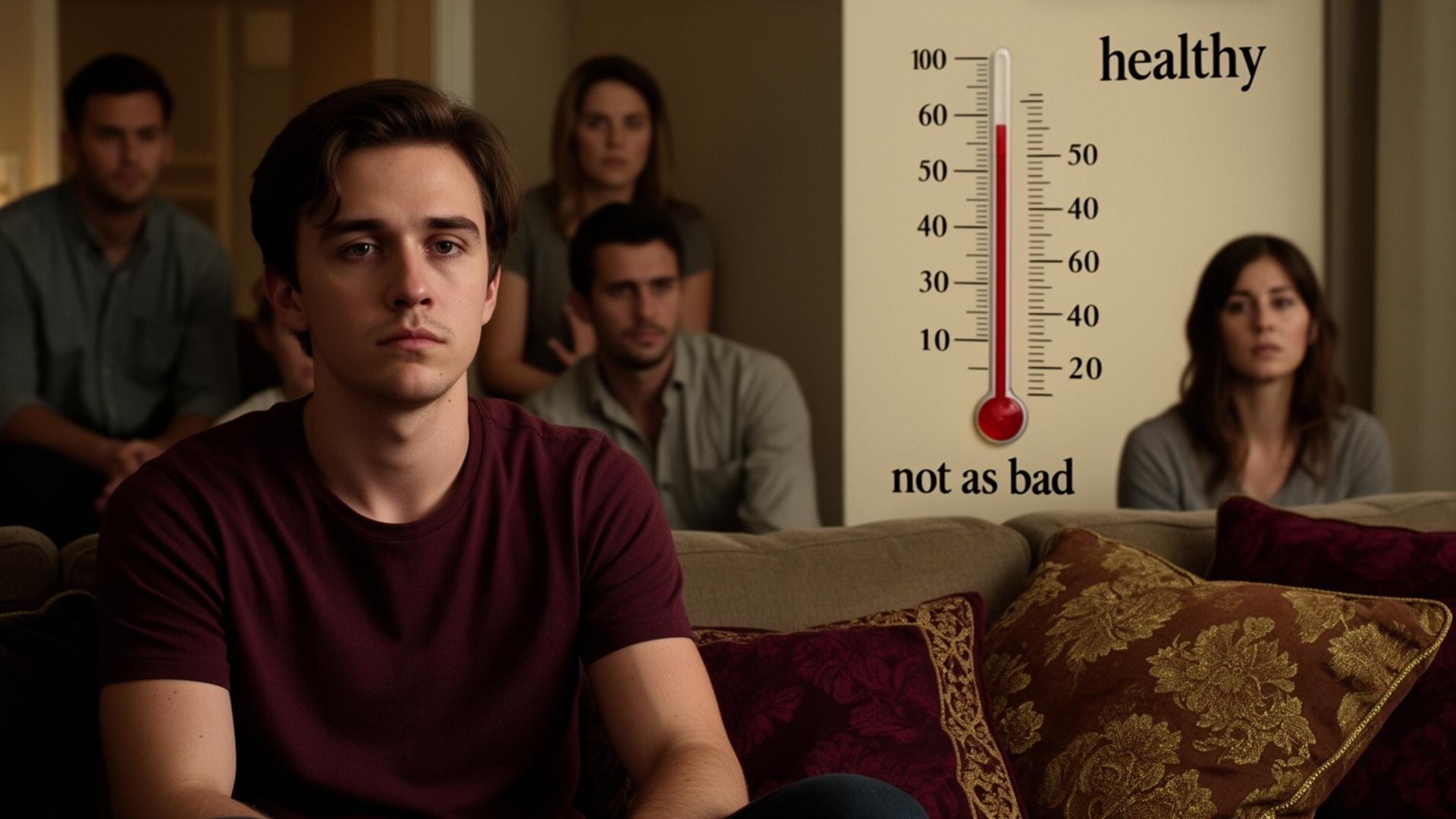
When addiction slightly improves, families often breathe a sigh of relief. Fewer blowups. Fewer missed days. Less visible chaos. And then comes the phrase: "At least it's not as bad as before." It sounds reasonable. It sounds hopeful. But comparison-based comfort can quietly freeze progress. Measuring addiction against its worst moments instead of against healthy standards keeps families stuck in a lowered baseline of expectation.
The Shifting Baseline Problem
Addiction changes the family's definition of "normal."
What once would have been unacceptable gradually becomes tolerable.
At first:
One missed commitment feels alarming.
Later:
Three missed commitments feel manageable because it used to be five.
The comparison shifts from healthy functioning to previous dysfunction.
That is the trap.
Why Partial Improvement Feels Like Recovery
If someone:
- Reduces use but doesn't stop
- Stops one substance but increases another
- Avoids legal trouble but continues secrecy
- Stabilizes work but remains emotionally volatile
Families interpret this as progress.
And sometimes it is.
But partial improvement is not full stabilization.
Improvement does not automatically equal recovery.
The Relief Effect
When crisis decreases, relief increases.
Relief feels good.
It lowers anxiety.
It restores hope.
It reduces tension.
But relief is not the same as resolution.
Many families mistake decreased chaos for sustained change.
Addiction can stabilize temporarily without truly shifting.
Comparing to Rock Bottom Is Misleading
If the benchmark is the worst moment:
Arrest
Overdose
Job loss
Explosive argument
Anything short of that feels acceptable.
But recovery should not be measured against collapse.
It should be measured against:
- Stability
- Accountability
- Honesty
- Emotional regulation
- Structural support
Lowering standards because things "aren't as bad" delays meaningful action.
The Illusion of Control
When behavior improves slightly, families feel more in control.
They think:
"It's leveling out."
"We've turned a corner."
"They're figuring it out."
But addiction patterns are rarely linear.
Temporary stabilization can precede escalation.
Comparisons hide trajectory.
Trajectory tells the truth.
The "High-Functioning" Trap
High-functioning individuals are especially vulnerable to this comparison error.
If they:
- Keep their job
- Maintain appearances
- Avoid public consequences
Families may accept ongoing problematic behavior because it is not catastrophic.
But internal instability can still deepen.
Functioning is not the same as freedom from addiction.
Emotional Memory Fades
The intensity of prior crises fades over time.
Families remember the worst moments emotionally—but daily life softens the urgency.
This emotional fading creates tolerance for suboptimal behavior.
The longer chaos is absent, the easier it is to lower expectations.
The Danger of Relative Standards
Relative standards sound like:
"It could be worse."
"At least they're not using every day."
"At least they're trying."
"At least they're not lying like before."
But relative standards normalize dysfunction.
Recovery requires absolute standards—not catastrophic ones, but healthy ones.
A Better Question to Ask
Instead of asking:
"Is this better than before?"
Ask:
"Is this sustainable?"
"Is this healthy?"
"Is this aligned with long-term recovery?"
"Are the underlying issues being addressed?"
Improvement without structure rarely holds.
Why Families Resist Raising the Standard
Raising expectations feels risky.
Families fear:
- Pushing too hard
- Reigniting conflict
- Appearing ungrateful
- Undoing fragile progress
So they accept "less bad" instead of requiring "healthy."
But stable recovery requires clarity—not gratitude for partial effort.
Progress vs. Plateau
There is a difference between:
- Gradual, structured improvement
- Plateauing in a less chaotic version of addiction
Plateauing often looks calm.
But without accountability, support, and behavioral restructuring, relapse risk remains.
The absence of crisis is not proof of recovery.
When Professional Perspective Matters
Families immersed in daily incremental change often struggle to assess objectively.
An experienced interventionist can help evaluate:
- Whether improvement is structural or superficial
- Whether support systems are adequate
- Whether boundaries are consistent
- Whether trajectory suggests stabilization or risk
Outside perspective reduces comparison bias.
A Party Wreckers Reality Check
"At least it's not as bad" is a low bar.
Recovery is not about being less destructive.
It's about becoming stable, accountable, and consistent.
If your benchmark is rock bottom, you will tolerate too much.
If your benchmark is health, clarity returns.
Final Takeaway
Minimizing addiction behavior through comparison creates comfort—but also complacency.
Partial improvement is not the same as sustained recovery.
Families deserve more than "less chaos."
They deserve stability.
Instead of measuring progress against disaster, measure it against health.
And if you're unsure whether what you're seeing is true recovery or just a calmer phase, professional guidance provides clarity.
Because "not as bad" is not the same as better.