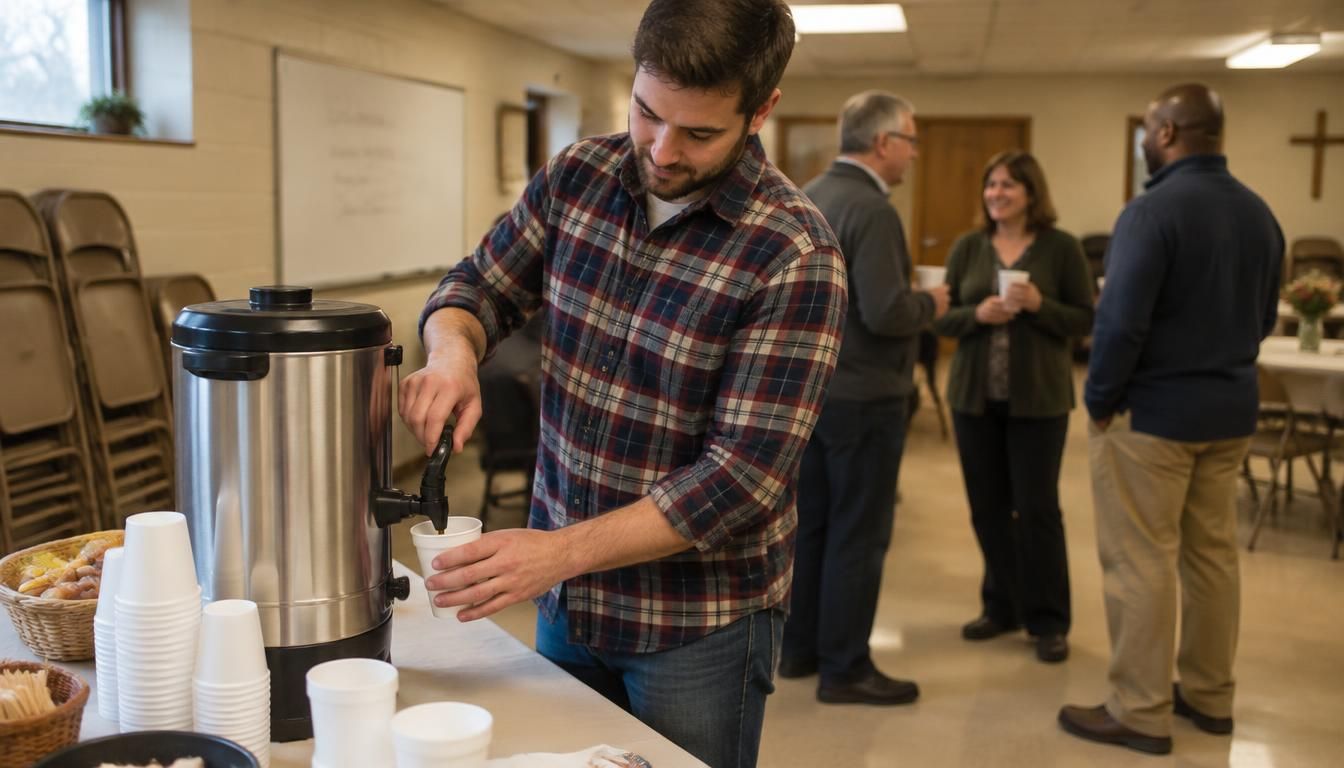
At about ninety days sober, an old-timer at my home group handed me a key and said, "You're on coffee. Tuesdays. Six-fifteen." That was it. No welcome speech, no job description. Just a key to a church basement, a 40-cup urn, and my first real lesson in service in recovery.
I was insulted. I wish I were kidding. A few months earlier I'd been convinced I was the smartest guy in every room, and now I was measuring Folgers into a filter at dawn for a bunch of people who were mostly going to complain that it was too weak. That coffee job turned out to be one of the most important things that ever happened to me.
Twenty-two years later, I'm an interventionist. Helping people is literally my job. But I learned the real lesson in that basement, with coffee grounds on my shoes.
What Is Service in Recovery?
Service in recovery means doing something useful for other people, usually without being paid or praised for it. It can be as small as setting up chairs or as big as sponsoring someone. The point isn't the task. The point is getting out of your own head long enough to show up for somebody else.
In active addiction, my whole world was me. What I wanted, what I needed, how I felt, who had wronged me. Every decision ran through one question: what's in it for me? Service flips that question around. It's a small, daily practice of thinking about someone else first.
Why Does Service in Recovery Work When Willpower Doesn't?
Service works because it gives you something addiction can't: a reason to show up that isn't about you. It builds accountability, connection, and self-respect at the same time. And it does it through action, not through thinking, which is good, because my thinking was the problem.
Here's what that coffee job actually did for me:
- It got me out of bed. When you're the coffee guy, twenty people are counting on you. On the mornings I didn't care about myself, I still didn't want to be the reason there was no coffee.
- It made me part of something. I wasn't the new guy standing in the back anymore. People knew my name because they knew my coffee.
- It gave me self-respect I couldn't think my way into. I'd spent years feeling like a fraud. Showing up every Tuesday for a year was a small, boring, undeniable fact. I did that. Nobody could argue with it, including me.
- It kept me close to newcomers. Every week I'd see someone walk in shaking, and I'd remember exactly where I'd been. That's the best relapse prevention I know.
There's an old saying in the rooms that you can't keep it unless you give it away. I used to roll my eyes at that one. Now I think it's the whole program in one sentence.
What Counts as Service in Early Sobriety?
Almost anything that helps someone else counts as service in early sobriety. You don't need years of clean time, a good story, or a single wise thing to say. You just need to be willing to show up and do something useful.
If you're new and wondering where to start, try one of these:
- Make the coffee, or ask the person who does if they need help.
- Set up chairs before the meeting or stack them after.
- Stand at the door and say hello to people as they come in.
- Clean up. Wipe tables, take out the trash, wash the mugs nobody else will touch.
- Pick up the phone when someone newer than you calls. Even if you're only two weeks ahead of them.
None of these are glamorous. My ego wanted a speaking slot and a round of applause. What I needed was a sponge and a little humility.
When Does Service Turn Into People-Pleasing?
Service turns into people-pleasing when you're doing it to be liked, to avoid your own feelings, or because you can't say no. Healthy service leaves you more connected. Unhealthy service leaves you resentful and exhausted.
I'll be honest: around year two, I overdid it. I was chairing meetings, sponsoring too many guys, answering every phone call at all hours. It looked great. Inside, I was running from my own stuff, just in a more respectable way. My sponsor finally asked me, "When's the last time you did any of this for you?" I didn't have an answer.
A Note for Families
If you love someone in addiction, this part matters for you, too. A lot of family members have been in "service" for years: covering, rescuing, fixing, smoothing things over. That isn't service. That's survival. Real service includes taking care of yourself so you have something left to give.
What Does Service in Recovery Look Like 22 Years Later?
Twenty-two years in, service looks like my work, my family, and still, occasionally, a stack of folding chairs. I wreck parties for a living now. The party of active addiction, that is. I get called into living rooms on the worst day of a family's life, and I get to say, "There's a way out. I know, because I took it."
But I don't count my job as my service. It's too easy to hide behind a business card. So I still go to meetings. I still take the late-night call from a guy at thirty days who's white-knuckling it. And every so often I still get there early and make the coffee, because it keeps me honest about where I came from.
That old-timer passed away years ago. I never really thanked him for that key. I think he'd tell me I'm thanking him every time I hand it to someone else.
If You're New, Here's Your Key
If you're early in sobriety and feel useless, restless, or stuck in your own head, find one small way to be of service this week. Don't wait until you feel ready or worthy. The feeling follows the action, not the other way around.
And if you're a family member watching someone you love struggle, hold on to this: the person you're scared for might one day be the one holding the door for someone else. I've watched it happen hundreds of times. I was one of them.
Make the coffee. Show up. Let it change you.